
The Winner Takes It All: How Jessie Buckley Re-wrote Hollywood
By Michaela Benedetta Lopez
ENTERTAINMENT
Edited by Francesca Sylph
5/7/20262 min read
©Getty Images
It is just as ABBA once sang, “the winner takes it all,” and that is what defined the 2026 awards season for Jessie Buckley.
When it comes to the Academy Awards, her victory goes beyond recognition: Jessie Buckley has quietly changed what it means to be a Hollywood star, becoming the first Irish woman to win an Oscar. In an industry long shaped by distance, perfection and carefully constructed ideals, Buckley represents something different: a new kind of diva, one defined by authenticity rather than untouchability.
For decades, Hollywood has built its icons around a very specific ideal. Figures like Marilyn Monroe and Elizabeth Taylor embodied a magnetic yet carefully constructed image, shaped to fit a defined standard. They were stars to be admired, but not truly accessible to the public. Their personas often depended on a sense of distance that separated them from ordinary experience.
Buckley, however, breaks this pattern. Unlike the divas of the past, she does not create distance between herself and the audience, but instead allows a more direct presence to emerge. Her performances are defined not by polish or perfection, but by emotional honesty. Rather than concealing vulnerability, she places it at the centre of her work.
This is particularly evident in Hamnet, where she plays Agnes, a mother confronting the loss of her child. Here, grief is neither controlled nor idealised; it is chaotic and difficult to endure. Buckley does not aim to make the character perfect, but human, showing that vulnerability can be stronger than perfection.
This emotional truth recurs throughout her career. It is evident in her portrayal of Sally Bowles in Cabaret, where she creates a character who feels immediate and deeply human rather than stylised or distant. A similar intensity appears in The Lost Daughter, which earned Buckley her first Academy Award nomination for Best Supporting Actress. In every interpretation, Buckley engages with complex representations of womanhood and motherhood, placing emotional experience at the centre of her performances.
Rather than idealising these roles, she presents them with honesty and nuance. Buckley consistently portrays women not as perfect figures, but as layered, vulnerable and real. Her ability to move between acting and musical performance reinforces her range, yet it remains grounded in authenticity rather than display.
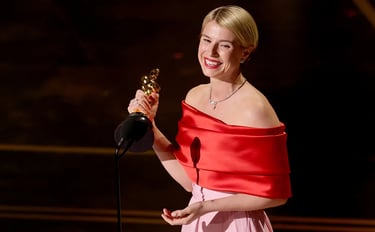
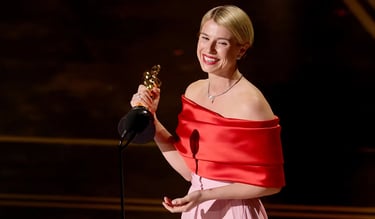
Her emotional honesty extends beyond the screen. In her Oscar speech, Buckley spoke about womanhood and motherhood, describing a mother’s heart as a “beautiful chaos”. It is not the distant language of traditional stardom, but something more immediate and lived, reflecting a broader cultural shift: contemporary audiences seek connection rather than distance.
Her career path also reinforces this image. She did not achieve success instantly or without setbacks. Early rejections and a gradual rise contribute to the perception of her as a more accessible figure, far removed from the idea of the untouchable star.
The dialogue between past and present is also visible in her public image. At the Academy Awards, Buckley paid tribute to Grace Kelly by wearing a Chanel gown similar to the one Kelly wore in 1965. Her bold red lipstick and swept-back blonde hair evoke a classic Hollywood aesthetic. Whether by coincidence or deliberate choice, the reference is too clear to ignore. Buckley wore that dress for her first win, just as Kelly did.
In this sense, Jessie Buckley is not simply following Hollywood’s ideals; she is reshaping them. She represents a shift from constructed and distant icons to more human and multifaceted figures, where power lies not only in talent, but in authenticity and emotional honesty.
For more, explore fashion, travel, and lifestyle insights here.
Subscribe to our newsletter!
info@femmine.co.uk