
Rewriting the Female Silhouette
By Alice Testa
FASHION
Edited by Hannah Mae Webster
4/5/20262 min read

Fashion rarely repeats itself. The return of the dropped waist on contemporary runways is less a revival of the 1920s than a reconsideration of how the female form is defined and framed.
In the early twentieth century, lowering the waistline was radical. The flapper dress rejected the corseted torso and fabric fell in a straight line from silk-wrapped shoulders. The body was no longer sculpted into ideal proportions but allowed to exist in motion. This shift wasn’t purely aesthetic; it reflected social change, new freedoms, and the emergence of a modern female identity less tied to domestic and moral expectations.
Yet the ’garçonne’ silhouette did not last. Its disappearance reveals that the waist is never neutral; its presence or absence always carries cultural meaning.
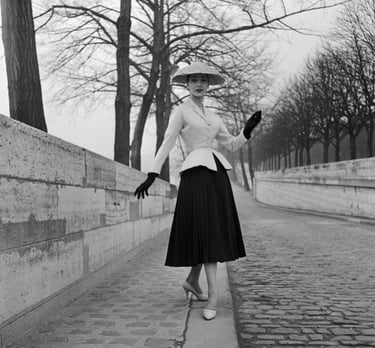
In 1947, Dior’s New Look restored the waist with theatrical precision: cropped jackets, padded hips, and full-on balloon skirts expanding from a tight waistline. Often described as a conservative reversal, it can also be read as a bold reclamation. The body was not confined but dramatised. Where the 1920s refused definition, the late 1940s performed it with extravagance. Both silhouettes negotiated liberation through shape – one erased, the other exaggerated.
Today's lowered waist returns in a culture already fascinated with body visibility. Designers unexpectedly displace proportion rather than eliminate it.
At Saint Laurent SS 2024, Anthony Vaccarello introduced tiny dropped-waist skirts and long trousers in faded velvet hung almost vertically, breaking only when the wearer walks. Similarly, Chanel AW 2024/25 used diaphanous fabrics and pleated flounces that softened the silhouette instead of defining the waist. Marc Jacobs' recent 2026 runway featured shapeless silhouettes, including jackets with no prominent shoulder lines and dresses that fell straight to the ankle. The lowered waist maintains legibility while moving the body's centre. One erases structure; the other displaces it.
This strategy has precedent. Cristóbal Balenciaga's mid-century innovations shifted structure away from the torso – balloon backs, semi-fitted fronts – making the body recognisable in its own absence. In the 1920s, the Western adoption of garments like the kimono replaced measurement with shapeless drape. Years later, Issey Miyake's pleated technology and focus on abstract movement paved a new road entirely.
Fashion moves simultaneously in parallel directions. Designers rarely reproduce the past; they reinvent it. Today, the flapper exists not as a person, but as a sensation: fluid freedom draped in memory. The aim is not accuracy, but resonance.
The dropped waist therefore functions as a subtle disturbance in proportion. Not rebellion, not nostalgia. A small shift in position that changes how the body is read – and how identity is performed – without declaring itself either past or future. It evokes a world rather than reconstructing one. In moving the waist, fashion once again reframes the body – proving that even the smallest shift in line can rewrite the notes of femininity.
©Dior
For more, explore fashion, travel, and lifestyle insights here.
Subscribe to our newsletter!
info@femmine.co.uk