
Post Polling Day: What The Local Election Results in England Really Mean
By Megan Smith
NEWS
Edited by Abby Lawrence
5/29/20263 min read
©Sky
Local elections took place across parts of England on May 7, alongside elections to the Senedd in Wales and the Scottish Parliament. Headlines in the days since have focused on the success of Reform and the Greens following their performances, as well as the unrest within the Labour Party after disappointing results, calling for Keir Starmer’s resignation.
The fallout from this set of local elections risk overshading their true purpose – national frustrations have diverted voters’ attention away from the importance of local government and their responsibilities.
What do these Elections Mean, and Why are they Important?
Evidently, voting at local elections is not valued compared to a general. The average turnout for the general election in 2024 was 60%, compared to locals that are often below 35%. Issues that plague residents in their everyday life are not the responsibility of the government but their local councils and mayoral authorities. Local councils set the budget, and have the power to raise or increase council tax and decide how the money raised from such taxes is spent. This can range from social housing, bin collections, SEND support, community safety and funding for cultural assets.
This year, there were elections for 136 councils, with over 5000 seats contested. In some areas, boundary changes meant that there were “all out” elections, meaning the residents voted for every councillor in their ward, rather than just one.
What the Results Show
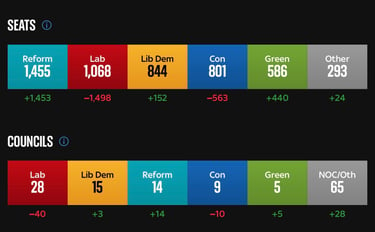
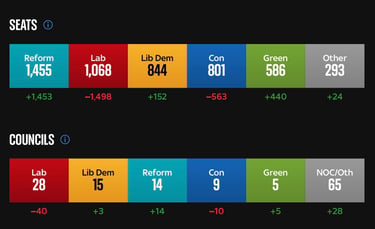
The results proved damaging for both Labour and the Conservatives, though Labour suffered the heavier losses. The Conservatives won 801 seats overall, but suffered a loss of 563. Labour meanwhile won 1,068, down 1,498 seats from previous elections. Reform UK celebrated huge successes, a relatively fringe party previously, they won 1,454 seats this time round. The Green Party and the Liberal Democrats also celebrated gains, with the Greens gaining 441 seats to win a total of 587. Meanwhile the Lib Dems gained 155 seats, ending the day with 844 seats. A large number of independent councillors also won seats, numbering 213 across England.
Of the six mayoral elections that took place, two authorities changed hands, with Lewisham and Hackney electing Green mayors in place of their Labour predecessors.
Labour lost control of 38 councils that were up for election, but were able to retain or gain control of 28. The Conservatives lost control of 6 councils and now control 9 of those contested. Reform moved from controlling none of the councils up for election to winning a majority on 14 councils. Similarly, the Greens increased their presence, gaining control of five councils after previously holding none. Meanwhile, the Liberal Democrats now control 15 of the councils contested in this round of elections.
The biggest shift however, was the rise in councils under no overall control. In some areas both the right and left-wing votes were split between multiple candidates. This results in 23 councils, where no single group achieved majority control, meaning a total of 64 councils were left under no overall control. These authorities will now require coalitions or cross-party agreements to govern effectively.
It is also important to note that many councils did not hold elections this year due to staggered electoral cycles making it a fallow year in some areas. This means the results provide only a partial picture of England’s political landscape.
What do the Results Tell Us?
The results are a significant indication of dissatisfaction with the two main parties. We may be witnessing the end of two-party politics, with the rise of small parties whose popularity outweighed the major players in some areas.
The political shift seems to be away from the centre in both directions, with Green and Reform gaining traction at opposite ends of the scale. Politics is clearly fragmented, with an increasing distrust in both the system and those within it, more voters seem drawn to parties that label themselves as anti-establishment.
National issues appear to have shaped local voting behaviour with concerns over cost of living, immigration and public services like the NHS named as reasons for voting.
Now, the challenge lies with residents to hold their elected representatives to account, calling for them to keep to their manifestos and make the changes they promised. But will some of these bold policies be achievable with the funding issues facing local authorities? Or will voters be left disappointed?
For residents, these election results are not just an indication of national political feeling. The decisions made shape the services they rely on, the streets they live on, and the communities they call home. Candidates should remember that local office is not just being part of a broader political movement but being a reiterative and advocate for the most vulnerable in society.
For more, explore fashion, travel, and lifestyle insights here.
Subscribe to our newsletter!
info@femmine.co.uk