
Pop, Protest, the Price of Visibility: Why CMAT's Euro-Country Matters Now
By Jess Pittendreigh
ENTERTAINMENT
Edited by Charlotte W
4/23/20264 min read
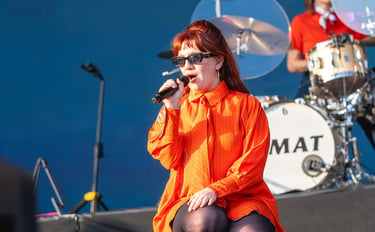

©Raph_ph, Wikimedia Commons
If you aren’t familiar with CMAT, we can start with the name itself: CMAT, or Ciara Mary-Alice Thompson, the self-titled ‘global celebrity teen pop sensation’ whose band catapulted to global fame following the release of the hit single Take a Sexy Picture of Me at the beginning of 2025. The song led the release of her album Euro-Country, which topped the charts a few months later. Despite this, I remained largely unfamiliar with CMAT until attending her set at Neighbourhood Weekender in May 2025, arriving entirely unaware of the force I was about to experience.
In typical UK fashion, terrible weather defined the day, and we found ourselves stuck beneath the collapsing folds of The Big Top Stage, soaked through by torrential rain. Preoccupied with emptying rainwater out of my boots during the interval, I failed to notice the sudden surge of tassels and cowboy hats gathering around me. Then, a campy tune began to play. Band members strutted onstage in boxers and glitter, followed by a diamante whirlwind of a woman, flirting with her toothgems under the spotlight. With festival crowds like NBHD’s audiences tend to be restless, difficult to hold. Enter: CMAT.
Thompson had the entire room in the palm of her hand — her performance, her self-confidence, her spectacle. The crowd swayed, two-stepped, laughed, cried — completely captivated by a woman so self-assured it seemed unthinkable that such a performance could emerge from her brutal encounters with the worst of what humanity has to offer: social media. An ironic contradiction — but somehow, it became her voice.
CMAT’s triumph was earned through gruelling encounters with — unsurprising to anyone — a predominantly male-driven body-shaming campaign that followed her performance at Radio 1’s Big Weekend festival in 2024.
Take a Sexy Picture of Me became her act of self-acquittal: a reclamation of her sexuality, and a refusal to let it collapse under any weight — least of all the endless contradictions of male desire. The song outlines the futility of trying to satisfy these demands, rejecting any impulse to shrink herself into a box she repudiates. But this is where CMAT’s genius sharpens into something undeniable.
She does not dilute the pain of a woman who once longed to be ‘sexy’ — whatever that even means — and is then forced to reckon with the cost of resisting that label. There is no neat dichotomy in her writing, no attempt to resolve the contradiction. Instead, she leans into it, refusing both to submit to expectation and to suppress the very real desire to. She remains a contradiction, fully intact — and it is precisely the refusal to simplify herself that makes her so powerful.
The double-edged sword of this is far from ironic. Prior to Euro-Country, she penned songs about matters of the heart; songs that fronted frustration, self-loathing, love, and loss. In her earlier work, patriarchy, the far right, her Irish identity — and the trauma born from these — beat under the music’s skin, hidden just out of earshot from those it might anger to hear it. It took enduring unwarranted, unrelenting judgment for these to take precedence, but it paved the way for CMAT and her band to reach global, BRITs-nominated acclaim.
Now, defiance of patriarchy, colonialism, and corruption is what drives her prowess. Even so, this doesn’t balance the precarity of the moral scales; the price paid, unwillingly, to get to this point. CMAT told Vogue’s Hannah Jackson that on the day of Euro-Country’s release, her manager “rang me this morning and was like, ‘Don’t go on Twitter today’”, emphasising that she felt like she’d “just been fed to the wolves”. Jackson furthered this, adding: “One byproduct of success, Irish singer CMAT is learning, is that one’s art becomes fodder for news. And with news comes thinkpieces”. Emblematised, it seems, into something allowed itself to be opposed — to be hated. Yet, despite the album being so divisive in its nature, it refuses to polarise itself. From enlisting Jamie Oliver to star in her ‘diss track’ music video, to indulging moments of vanity on stage, she refuses to let her human contradictions fracture her music; instead, they become her strength.
With her hybrid pop-country tone and unflinching but deeply vulnerable lyricism, CMAT transforms her defiance into an all-dancing, anthemic experience that expands beyond meaning into a bodily indulgence: flushed, dizzied, hot, alive — human.
Suddenly, then, a crowd of nearly 4,000 people inside the O2 Victoria Warehouse is transformed into a statement, a movement, a unity. A community, bound together and dancing in one singular space. The themes Euro-Country reckons with — the trauma of growing up in Dublin in the 90s amid an influx of male suicide, an economy run to ruin, and a country fractured by division — are unbracing, and more real than ever today. But told in a bilingual, folk-country manner, she lays down her roots through seanchas — the Irish tradition of oral storytelling — sharing her country, her family, and herself, and inviting us to share ours too.
Though there are pockets of community that exist to instil positive change within an ever-expansive online space, these are pulverised by a singular swipe — to the comments, to the next post, to hidden camera footage of animal abuse, police brutality, mass deportation, war, red-pill podcasters. Move away from their avid online supporters, and there are eyes undressing women in skirts, hesitation before nighttime runs, casual misogyny loitering in the words of male friends and family. There is futile empathy — for animals we abuse and call ‘livestock’, for Palestine, for the Congo, for Sudan, for terrified, war-struck people from war-torn places, hollowed and cast out by the ‘Immigrant’ label — with no place for it to go, least of all any place that seems to make a difference. There is hypocrisy — in others, in ourselves.
The room CMAT creates is a room full of people who believe in everything she sings. Who may not understand the complexities of what it means to be a gay, Catholic, Irish woman — a woman at all — or whose struggles remain unsung in her music. But who recognise that it is as much the parts they can’t name, as the ones they can, that make someone whole. Someone beside them, in front of them, two hours or two continents away. Someone who loves, who has lost — as we all have, and as we all do, regardless of anything or everything else. In holding that line, she opens up something rare — irreconcilable, incomplete, but real enough to reach for. And that outline of unity is the beginning of the best we can do.
John Harris writing for The Guardian, argued that CMAT’s power lies in her defiance, not division: “[This] is why it is such a brilliant carrier of something that this year sometimes threatened to snuff out: a very human kind of hope”.
For more, explore fashion, travel, and lifestyle insights here.
Subscribe to our newsletter!
info@femmine.co.uk