
On Letting Life Get Messy: Lorelei, Rory, and The Art of Redirection
By Polly Buckley
ENTERTAINMENT
Edited by Charlotte W
2/22/20264 min read
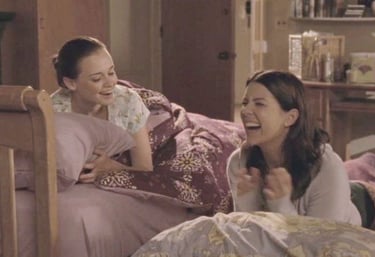

"People can live a hundred years without really living for a minute."
Few material things provide me with more comfort than You Jump, I Jump, Jack. There is something quietly transformative about revisiting Gilmore Girls. Beyond the witty dialogue and cosy small-town charm, a rewatch becomes a meditation on life itself: on how failures and detours often lead to the most meaningful destinations. It reminds us that comfort and growth can coexist, that a bad day can brew into something beautiful.
The title quote epitomises the show’s ability to nurture gentle introspection. In You Jump, I Jump, Jack, we follow the beginnings of Logan and Rory’s romance, but the episode itself focuses on the quiet power of carpe diem. Before this, Rory almost seems swallowed up by Yale. Acting much as she did at Chilton, she sticks by Paris and often returns home to see Dean. The latter evidences a regression in Rory; she behaves as her teenage self to find comfort in an unfamiliar young adult environment where she is afforded less limelight. It takes Logan, and the success of her piece on the Life and Death Brigade, to pull her out and bring her back to the goal-oriented, hard-working person she is.
You Jump, I Jump, Jack does not just shift Rory’s story; it transforms it, leading her from Yale’s promise to a much messier kind of freedom, which is significant to her coming of age. The comfort I find in this episode, and in the series more broadly, lies in its balanced celebration of all forms of redirection: of ‘failures’, which are seldom portrayed as such, and of ‘wins’, which equally have their lows. What Rory’s character and this episode epitomise is that taking leaps is part of becoming; her arc in this season and the next teaches us that becoming is not linear. Coming of age, Gilmore Girlssuggests, is not marked by milestones – a marriage, a career, an age – but by the ongoing moments in which we come to know ourselves a little better. A Year in the Life makes this clear: Rory is nowhere near the life she once imagined, yet she is still growing.
Focusing on seasons five and six, Lorelai’s character offers a different kind of comfort, rooted in the same warmth, forgiveness, redirection and expected retrospection, but expressed in new ways. In these seasons, Lorelai has everything the audience has wanted for her. She and Luke are together, and she has just opened the Dragonfly with Sookie. All of this, however, coincides with significant lows: her argument with Rory after her Yale dropout, the delay of her marriage to Luke, and her ultimately seeking comfort in Christopher. At this point, Lorelai is largely a victim of the actions of those around her, such as Luke neglecting their relationship upon discovering April, and Rory’s late wave of teenage rebellion, spurred by Mitchum Huntzberger’s comments.
Lorelai is an exceedingly human character. She is admirable in the sense that she is continually performing her own art of becoming, teaching us that growth, retrospection and redirection continue into early adulthood. As a pre-teen, I idolised Lorelai and, hilariously, thought she was the picture of adulthood, which feels ridiculous now that I am nearly her age in season one. Still, she remains a touchstone for me, a reminder to lead with my heart and remember that self-love often looks like forgiveness. Lorelai’s ‘weak point’ is Christopher, and this comes to a head at the end of season six when she sleeps with him, knowing it will cause her to lose Luke (albeit temporarily). But much like Rory dropping out of Yale, Christopher actually serves as a point of redirection. This ‘low point’ eventually brings her back to Luke, as she finally realises she does not want to be with Christopher at the end of season seven.
Yet this is not this ‘low point’s only significance. I previously noted that a Gilmore Girls rewatch can awaken a meditation on life itself. In moments like these, forgiveness is not the point; it is the recognition that life’s inevitable messiness – across love, work, and family – is what gives it shape and meaning. Though they are not together when Lorelai sleeps with Christopher, this is a profound betrayal, but an achingly human mistake; an exceedingly relatable moment of self-sabotage. Perhaps that is the lesson to draw from this moment: not that failure guarantees forgiveness, but that forgiveness itself is not always what we need, what is right, or what is even possible. Sometimes growth lies not in being redeemed but in accepting a new direction.
Lorelai is a complex woman whose woes and moments of redirection expand our emotional vocabulary. She lives by the quiet truth that many things can be true at once. She is in love with Luke, yet will always, differently, love Christopher. Rory remains her world yet becomes both her frustration and her solace, a mirror through which her own failings soften. Her mother is difficult, but her love runs deep. In the end, Lorelai’s failures become lessons, and her triumphs, rarely simple, shimmer with imperfection. Ultimately, she is painfully human yet tirelessly inspirational; made whole by the imperfections that never leave her, by her love and dedication to those around her, and by her ability to follow her heart, sometimes over her head.
All in all, a rewatch of Gilmore Girls fosters introspection, self-love, forgiveness and celebration in all aspects of our lives. It is a love letter to ambition and affection alike, to women who chase career goals, romantic ideals and personal fulfilment with equal passion. To women who accept that messiness is part of being alive, that failure is inevitable, but so is success. A rewatch is not just nostalgia; it is a way to romanticise the present or find the courage to face it head-on, to expand our emotional vocabulary and find comfort in how the rhythm of Stars Hollow mirrors our lives. A lesson, in the end, that understanding, forgiving and fighting for ourselves is the best we can do.
©Pinterest, Warner Bros.
For more, explore fashion, travel, and lifestyle insights here.
Subscribe to our newsletter!
info@femmine.co.uk