
Egyptomania: A Curious Fashion Collision
By Hannah Mae Webster
FASHION
Edited by Cece Wilson
3/29/20262 min read
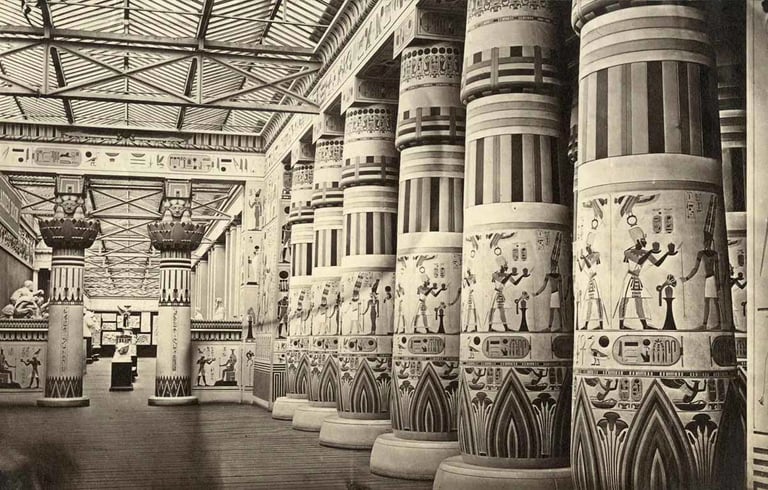
Shrouded in mysticism and spellbinding imagery, ancient Egypt’s enduring allure has long captivated Western imagination. From lapis lazuli and serpent-wrapped amulets to monumental silhouettes and gilded ornament, its collision with Western fashion irrevocably shaped visual culture. This fascination — termed Egyptomania — describes recurring waves of obsession with ancient Egyptian aesthetics across Europe.
Although often filtered through an overtly orientalist lens, Egyptomania profoundly influenced decorative arts, architecture, and dress. One early surge followed Napoleon Bonaparte’s 1798 invasion of Egypt, which ignited elite French interest in antiquity. Neoclassical fashion absorbed Egyptian motifs, producing columnar Empire silhouettes, weightless drapery, and jewellery adorned with scarabs, serpents, lotus flowers, and sphinxes. Headdresses, shawls, and sashes travelled far beyond their cultural origins.
The craze intensified in the Victorian era, when Britain’s 1882 occupation of Egypt coincided with heightened spiritualism and fascination with mortality. Egyptian artefacts and replica jewellery — particularly scarab motifs symbolising rebirth — became highly desirable. Designers such as Paul Poiret embraced theatrical ‘exoticism’, romanticising non-Western dress through stylised reinterpretation.
Egyptomania reached its zenith in the 1920s after Howard Carter discovered Tutankhamun’s tomb in 1922. The revelation of more than 5,000 treasures electrified the West and reshaped the emerging Art Deco aesthetic. Post-war exuberance fused with pharaonic imagery to produce symmetrical geometry, stylised natural forms, and lavish gilding. Fashion mirrored this opulence through beading, feathers, draped gold fabrics, and Egyptian-inspired costume masquerade among the elite — Cleopatra a perennial favourite.
Jewellery houses translated antiquity into luxury adornment. At Cartier, Jacques Cartier and Louis Cartier sourced archaeological fragments to incorporate into modern designs, blurring past and present. A winged scarab brooch convertible into a belt exemplified this approach. While contemporaries such as Bvlgari and Van Cleef & Arpels explored similar motifs, Cartier’s use of authentic antiquities proved especially distinctive.
The Second World War curtailed Egyptomania’s extravagance, yet revival arrived in the 1960s–70s through popular culture and museum spectacle — notably Cleopatra starring Elizabeth Taylor and Richard Burton, and the British Museum’s Treasures of Tutankhamun exhibition (1972). Amid youth counterculture and global curiosity, Egyptian references resurfaced once more.
Contemporary runways continue to reimagine Egyptomania. Balmain’s Resort 2023 collection fused scarab minaudières, cobalt-and-gold palettes, and serpent-wrapped torsos into a maximalist pharaonic vision under Olivier Rousteing. At Chanel Pre-Fall 2019, Karl Lagerfeld staged pyramid clutches, kalasiris-inspired gowns, and gilded headpieces against the Temple of Dendur. Alexander McQueen’s Autumn/Winter 2007 show invoked darker Egyptian symbolism through gold body armour, lapis hues, and serpentine forms.
Historically, the West has consumed ancient Egypt as embellished fantasy, selectively aestheticising its past. Yet Egyptomania’s legacy endures: fashion continues to mine antiquity for imagined worlds, poised between homage and projection — an enduring tension between art and truth.
©Architectural Digest
For more, explore fashion, travel, and lifestyle insights here.
Subscribe to our newsletter!
info@femmine.co.uk