
Cut for Credibility
By Ana Aritio
FASHION
Edited by Charlotte W
5/3/20262 min read
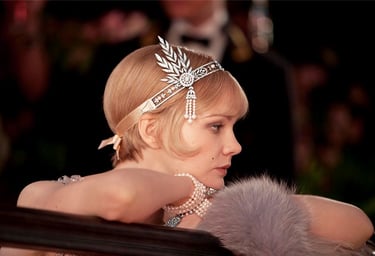
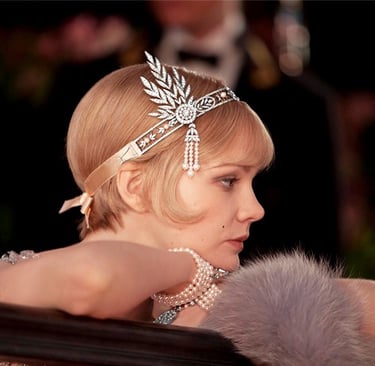
In The Great Gatsby, directed by Baz Luhrmann (2013), every significant jewel is Tiffany. This is not a flourish of costume design but a deliberate styling choice. Working with costume designer Catherine Martin, Luhrmann did not simply accessorise Fitzgerald’s world; he constructed it in platinum and diamond, grounding Gatsby’s performance of wealth in American Art Deco. Tiffany & Co. created jewellery specifically for the film, embedding the house into its visual identity and establishing it as cinematic shorthand for modern American affluence.
By the 1920s, Tiffany & Co. had refined a distinctly modern aesthetic. Art Deco rejected the soft curves and sentimental ornament of the previous era in favour of symmetry, geometry, and clean lines. Rectangular emerald cuts, slender baguettes, stepped settings, and radiating sunbursts echoed Manhattan’s skyline. Platinum settings, cool in tone and technically exacting, allowed for finer prongs and lighter frameworks, making diamonds appear almost suspended against the skin. Under electric light, the metal intensified brilliance without gold’s warmth, producing a crisp luminosity that felt unmistakably contemporary.
That approach defines the jewellery in The Great Gatsby. Daisy’s Savoy headpiece sits low across the brow, flattening the crown and reinforcing the dropped-waist silhouette of the flapper era. Long, articulated earrings frame her jaw and neck, catching the light as she moves. Diamond bracelets stack at the wrist, their straight-edged settings echoing the fall of bias-cut gowns and beaded chiffon. The diamonds do not merely sparkle; they structure the frame.
The film’s maximalism works because every element is visually coherent, even at its most opulent. When Daisy leans into Gatsby, the platinum at her throat appears almost weightless, the stones resting directly against the skin so that wealth feels immediate and tactile.
Tiffany’s authority extends beyond West Egg, but it always operates through design. In Breakfast at Tiffany’s (1961), Audrey Hepburn’s slim black dress is completed by layered pearls and, in publicity imagery, the Tiffany Yellow Diamond set in a Jean Schlumberger necklace, balanced by sculptural gold framing the collarbone. Decades later, in Death on the Nile (2022), the Yellow Diamond sits high at the décolletage, dominating the neckline and catching light before the wearer moves. More recently, Frankenstein (2025), directed by Guillermo del Toro, reportedly incorporates archival Tiffany pieces from the late nineteenth and early twentieth centuries, using period-authentic metalwork and settings to reinforce historical continuity.
Across decades, Tiffany recurs in cinema because it performs under light. Platinum settings and geometric cuts translate cleanly on screen, and their scale reads instantly. Directors return to Tiffany not only because it signals wealth, but because it perfects how wealth is cut, set, and styled for the camera.
Yet The Great Gatsby remains the most distilled expression of that visual language. The green light across the bay may gesture towards hope, but Tiffany diamonds render aspiration concrete. Cut with intention, set in platinum, and placed to frame the face and lengthen the body, they transform desire into something visible and defined. Luhrmann’s exclusive use of Tiffany makes the spectacle visually irresistible, even as the narrative questions it.
Diamonds endure, dreams fracture, and cinema keeps returning to Tiffany to rehearse the same language of luxury: fluent, dazzling, and never quite enough.
©Warner Bros.
For more, explore fashion, travel, and lifestyle insights here.
Subscribe to our newsletter!
info@femmine.co.uk